
Tips for First Drafts: Plot

Today, we are jumping into the third installment in our series on editing first drafts. Be sure to check out Parts 1 and 2 for advice on refining your themes and characters.
Note: This series is directed primarily toward fiction writers. Nonfiction friends are very welcome, but may not find as many practical takeaways as their fiction counterparts.
You’ve finished your first draft. Nice.
The work continues, however, well past that final period. It’s time to take a good, hard look at the plot of your story.
Whether you’re brimming with confidence in your story’s framework or you’re haunted by the vague notion that something’s wrong although you can’t for the life of you put your finger on the problem, it’s a good idea to double-check the logic of your story. A confusing plot will rob your work of emotional resonance.
“But I write literary fiction,” you may protest. “It’s open to interpretation. The whole point is to leave haunting questions swirling around the readers’ heads once they’ve finished the book.”
Open-ended questions are one thing; a disjointed, nonsensical plot is another. You may think you can get away with weak plotting so long as there is a big emotional hook, but the best stories incorporate both logic and emotion.
Here are a few tests you can apply to your book to help you determine the strength of its plot:
The Dominoes Test
One of the best books I read as university student was a thin little manual called Backwards & Forwards: A Technical Manual for Reading Plays by David Ball. As you can probably guess from the title, the book focuses on the components of playscripts, not novels; however, I find that many of the ideas can be transferred between mediums. After all, both plays and novels are explorations of the same age-old question: What exactly is the human condition? And—the question most of us become interested in sooner or later—how on earth do we manage it?
David Ball suggests an absurdly simple method for mapping out the events of a story. The images he employs are striking enough that I still think back to them, years after reading the book:
If I do anything that leads you to do anything, together we have an action. If I fire a gun at you and you fall over in a dead heap, we have an action. Your first task when reading a play is to find each action: find each action’s first event (its trigger), then its second event (its heap)…
Each trigger leads to a new heap. (Each event causes or permits a second event.) That is one action. But now the heap, the second event, becomes a trigger: a new first event of a new action…
If you can discover such connections between events, you will be able to take us, step by step, event by connected event, action by action, right to the heap of bodies at play’s end. [This is a reference to Hamlet, which Ball uses as his exemplar throughout the book.] But if you can’t, then no matter how much you understand character or meaning or Freud or world views or philosophy, you can’t stage the play. Unfortunately, that rarely stops anyone from trying. 1
Ball goes on to compare the events of a play with a line of dominoes: one domino falls into the next, which falls into the next, and so on. In a story, this clarity of motion provides the reader with a sense of safety, even if the events themselves are dangerous or horrifying. Underneath it all, there is a logic that makes sense. This logic can help to build suspense (as the reader watches the dominoes fall with mounting dread), or it can merely help to clarify what might otherwise be a complicated storyline.
Try this exercise!
Map out the plot of your story using the domino method (or what David Ball refers to as “trigger and heap”). Grab a pencil and a scrap piece of paper and jot down the actions in your story from beginning to end. What is the very first thing to happen in your story? That is your first domino. What, from that first event, is triggered to happen next? What does that event, in turn, cause to happen?
If you get to a point in your plot where you seem to have a domino that isn’t connected to the others (nothing caused it to happen or nothing comes of it), consider removing that part of the story. “But I wrote it so beautifully!” I hear you cry. “It’s such a lovely moment!” I understand. But it behooves every serious writer to heed the advice of the former Cambridge professor Sir Arthur Quiller-Couch who once said: “Whenever you feel an impulse to perpetrate a piece of exceptionally fine writing, obey it — whole-heartedly — and delete it before sending your manuscript to press. Murder your darlings.” 2
Once you’ve identified the parts of your novel that should be removed (these could be paragraphs or entire chapters), I recommend saving your deleted material in a separate document. Over and over again, I have found the simple knowledge that those murdered darlings still exist actually helps me to let go of them. Occasionally, I even go back and resurrect one of them, having found a use for it after all (a rare, but thrilling experience).
I would opine that novels are a bit more intricate than plays. As you put your manuscript to the domino test, you may find that there are important character moments that pop up, seemingly without being triggered by a previous event. Perhaps your novel incorporates flashbacks. Maybe you have an ensemble of characters and so you have multiple strands of cause-and-effect actions occurring simultaneously. Don’t sweat it. Real life is messy; good literature will reflect that. The point of the exercise is to identify glaring holes in your plot—things that just outright make no sense. Focus on finding those.
Note:Daphne Gray-Grant has a punchy and poignant post on the necessity of murdering your darlings on her Publication Coach website, if you’re interested in reading more.
The Seismograph Test
Another way to track the plot of your novel is to plug the events into a plot diagram. No doubt you’ve seen some version of the plot diagram before—basically a glorified scalene triangle. The longer left side is the rising action, the triangle’s highest vertex is the climax, and the shorter right side is the falling action. At either end, we have the exposition and the resolution.
Typically, the plot diagram is drawn using straight lines. But what if the lines reflected the smaller beats within the story, the way a seismograph tracks tremors within the earth? This could draw a writer’s attention to segments of the plot in need of attention.
Try this exercise!
Grab a large sheet of paper and a pencil. Determine the first action that occurs in your novel, and note it as a short spike in the bottom left corner of your page. Before you draw the line for your second action, ask yourself whether it increases or decreases the tension/conflict in the story. If the second action creates suspense, draw the next line going up; if the second action decreases the suspense, let it fall.
Follow this method until you get to the final action of the story. Hopefully, your lines—although they may jump up and down like a seismograph—show the general structure of a traditional plot: an overall rising of tension leading up to the climax of the story, and then a falling of the tension once the climax has passed.
Here is an example to give you an idea of what yours could look like:
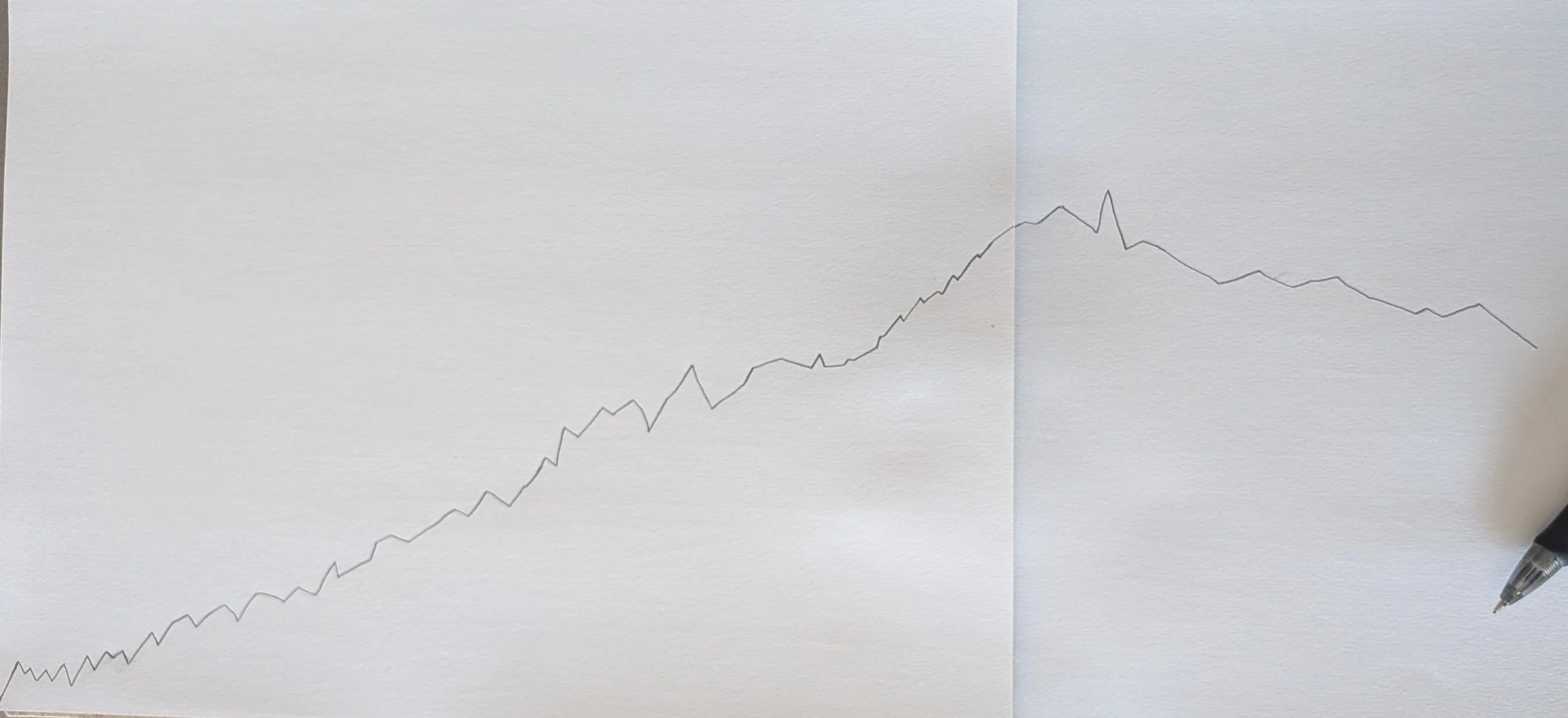
If your lines are behaving strangely—for example, you don’t see a climax or you have more lines going down than going up—you may want to focus on those parts of the story in your rewrites.
The Human Test
It is remarkable—remarkable—the things I have missed in my own work that others have pointed out to me. A scene might be perfectly clear in my head, but a beta reader tells me they couldn’t picture it. Or there is part of the story where I fluffed the details, and lo and behold, my beta reader locks in on the weakness like a shark scenting blood in the water.
We writers spend a lot of time alone in our heads with our stories. When we finish a book, we may sense that there are problems to solve, but we don’t have enough distance from our work to be able to see them clearly. If you have people you trust who will read your work and give you honest feedback on which parts of the story don’t add up, that can be infinitely more helpful than spending long hours on your own, scrolling from page to page, tweaking sentences and feeling unsettled.
If you’re handing your work over to a beta reader, I advise being specific about the feedback you request. For example, you could ask questions like, “Does this part of the story make sense?” or “Are there any moments that pull you out of the story?” Giving your readers targeted questions to focus on can save them the headache of looking for misplaced commas or spelling errors if that’s not the stage of editing you want to tackle.
No matter the genre of fiction you’re writing, plot matters. People want to read stories that ring true. They want to recognize the logic of the events even as they gasp in astonishment at twists they didn’t see coming. Your story doesn’t need to be boring or predictable; you can have mystery, tragedies, miracles, and magic, and still maintain a cause-and-effect logic between the events. You want your reader playing dominos, not Whack-A-Mole.
References
Ball, David. Backwards & Forwards: A Technical Manual for Reading Plays. Southern Illinois University Press, 1983.
Quiller-Couch, Sir Arthur. On the Art of Writing: Lectures Delivered in the University of Cambridge, 1913–1914. Cambridge: University Press, 1916; Bartleby.com, 2000. www.bartleby.com/lit-hub/on-the-art-of-writing/